

How Can We Do More?
Three Goals Through Research


01
To determine if the combination of the cash infusion and peer support groups results in stronger outcomes than the cash infusion or the peer support groups intervention alone.
.jpeg)
02
To examine the impact of the cash infusion on participants’ financial health, social connection, food security, emotional well-being and agency compared to participants who do not receive the cash infusion.

03
To examine the impact of the peer support groups on participants’ financial health, social connection, food security, emotional well-being and agency compared to participants who do not participate in peer support groups.
With additional investment, we can expand the program, collect larger and more rigorous data, and answer one of the defining questions of this moment: What actually helps families navigate a rapidly changing economy? The early results point to a powerful truth. Cash matters. Community accelerates impact. And funders now have a chance to help scale a model that could redefine what economic mobility looks like for families across New York and beyond.
The creation of peer support networks was a unique component of the pilot that is not found in existing examples of unrestricted cash infusion only programs.

“Through this program, doors opened for my small business, for meeting other people, and realizing I’m not the only one with needs. We all have them… I hope more families get the chance to experience this beautiful, simple program. Even though it seems small, it’s something very big for a family.”
-Carmen

The People Behind the Program
Read more on how Cash+Community Works has helped the people in our communities.
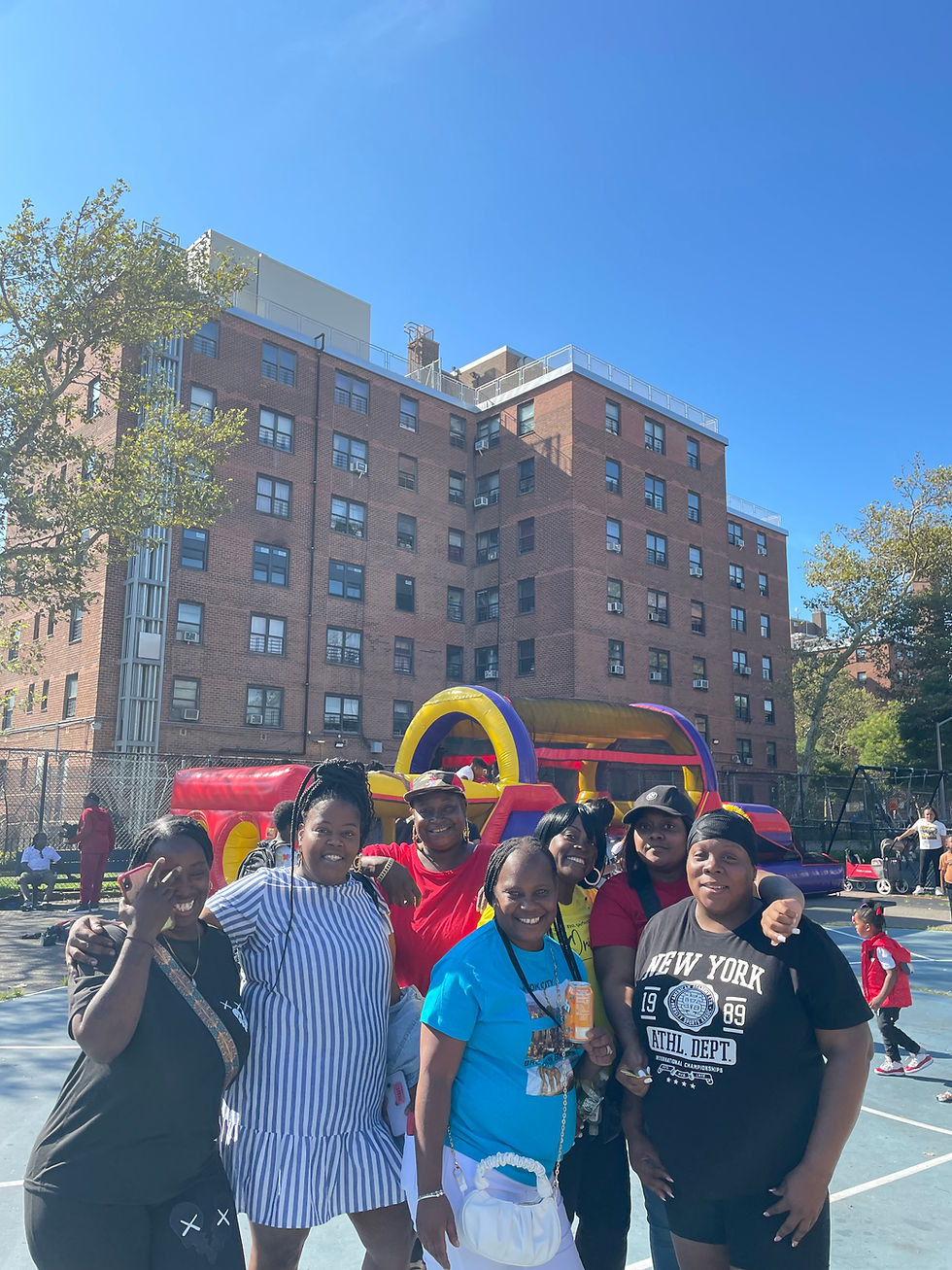
Community Unity Cultural Celebration of Kwanzaa
Rockaway residents celebrated Kwanzaa this holiday season the way they strive to live every day: with neighbors helping neighbors and celebrating their rich culture and each other. It all came together at the second Annual Community Unity Cultural Celebration of Kwanzaa on December 28 at B.R.I.D.G.E Family Enrichment Center. The celebration was sponsored and supported by several community organizations and attended by 180 Far Rockaway community members and friends. Thirty people served on the steering committee, making it a truly joint effort. Vernell applied to C+C and used the incentives to launch a grassroots nonprofit, Rockaways Neighbors Helping Neighbors. The organization serves as a conduit for exactly what the name says—neighbors and helping neighbors—and for bringing the community together. The annual Kwanzaa celebration is one of many ways Vernell accomplishes this goal.

Eudora's Story
At The Child Center’s 70th anniversary gala, Eudora spoke powerfully about her experience as a promising entrepreneur. Watch the above clip to see how she was able to start a marketable business through C+C—and pay it forward.

Empresarias Soñadoras
Meaning “dreaming entrepreneurs,” the name Empresarias Soñadoras embodies the spirit of Cash+Community Works. The Empresarias Soñadoras was one of our first cohorts. Most of them have children enrolled in a Child Center early childhood education program. The group has a vibrant, positive energy, and participants immediately connected with each other and their businesses, which range from baking to piñata making. They are quick to share resources and ideas on business development or their children’s education. Many connect on the fact that they are immigrants beginning a new life in the United States. They encourage each other not to limit themselves or keep their heads down the way they say they instinctively do.


Cash+Community Works Research Project
INFUSE: INcome and FUnctional Social Engagement
Beyond Basic Income: Does peer engagement enhance the effectiveness of unrestricted cash infusion?
Rationale for Research
C+C Works Pilot showed positive outcomes for its three short-term goals:
Improvement in financial situations
Improvement in well-being
Creation of peer support networks
The creation of peer support networks was a unique component of the pilot that is not found in existing examples of unrestricted cash infusion only programs. Does the additional peer support component enhance economic mobility and over all well-being?


Proposing 3 Aims Through the Research
1.To determine if the combination of the cash infusion and peer support groups results in stronger outcomes than the cash infusion or the peer support groups intervention alone.
2.To examine the impact of the cash infusion on participants’ financial health, social connection, food security, emotional well-being and agency compared to participants who do not receive the cash infusion.
3.To examine the impact of the peer support groups on participants’ financial health, social connection, food security, emotional well-being and agency compared to participants who do not participate in peer support groups.
Collect both quantitative and qualitative data to measure the following six areas using a mix of validated and non-validated measures including C+C Works pilot measures, Open Research measures and other well established data collection instruments.
Financial Health
Food Security
Social Connections
Emotional Well-being
Agency
Goals and New and/or Expanding Businesses
Treatment Groups and Control Group During 18 Month Intervention
Treatment Group A: Two interventions-monthly cash, grant funds, transition cash and peer support with monthly peer cohort meetings
Treatment Group B: One intervention-monthly cash, grant funds, transition cash
Treatment Group C:
One intervention-peer support with monthly peer cohort meetings ($50 incentive for submitting surveys/journals and being interviewed)
Control Group D:
No interventions ($50 incentive for submitting surveys/journals and being interviewed)
Eligible Participants
-
18 yrs.- 60 yrs.
-
Resides in Queens
-
250% Federal Poverty Level and below
-
Did not participate in C+C Works Pilot
-
Is not a TCCNY employee
-
English Proficiency

No Separate Application for Grant Funds
Rationale:
-
Not necessary for a separate application since everyone is receiving a grant.
-
Additional questions will be added in V1 survey/journal at the 3rd month for Groups A and B to ask how they plan to use the grant and whether it is related to their goals.
-
Additional follow-up questions will be asked in quarterly survey/journals for Groups A and B about how they used their grant money.
Post 18 Month Follow-up Phase
$50
Per participant for each submission of a quarterly on-line survey
$50
Per participant for in-person interview survey @ 36th month
#300
Total cash disbursement per participant in all 4 groups
-
Quarterly on-line surveys are same versions as during intervention phase.
-
Final in-person interview survey is same version as Core in-person interview survey during intervention phase.
Stratified Randomization Process for Treatment and Control Group Assignment
1.
Interested participants complete an on-line enrollment form to identify eligibility based on eligibility criteria during recruitment.
2.
Eligible participants are first grouped within neighborhood clusters.
3.
Within the clusters, participants are stratified according to demographic characteristics such as age, sex, income, race.
4.
After being stratified, participants are randomly selected into the 3 treatment groups and 1 control group to assure there is a similar number of participants with similar demographic characteristics among the 4 groups.
Full Power Analysis with English Only Language
1,040
Sample Size
220
English speaking participants in Treatment Groups A and B
300
English speaking participants in Treatment Group C and in Control Group D
300
Sample size for Groups C and D to account for attrition
Considered a full power analysis because there is a large enough sample size of similar participants in each group; confident that data comparisons will be credible.
18 Month Intervention Phase
.png)
Costs for 18 Months Intervention
-
Full Time Staff = $553,990 (includes fringe)
-
1 Project Leader
-
3 Liaisons
-
-
Part Time Staff = $32,120 (18 hrs per week)
-
10 interviewers @ 1st and 18th months
-
2 hours of training for interviewing
-
-
Cash Disbursements
-
$6,650 per person in Groups A and B = $2,926,000
-
$900 per person in Groups C and D for monthly journals = $540,000
-
$25 per person in Focus groups (20% of total treatment is 148) = $3,700
-
-
OTPS for 18 months intervention
-
$9,000 for laptops and phones for FT staff
-
$1,400 fee for IRB approval
-
-
Total Costs for 18 months intervention
-
$4,066,210 for monthly journals
-
-
Total Costs for 2nd 18 months follow-up = $782,914
-
1 FT Project Leader and 2 FT Liaisons
-
11 PT Staff at 36th month for interviewing
-
Cash disbursements @ $300 per person = $312,000
-
-
Total Costs for 3 Year Research
-
$4,849,124
-
Research Study of Pilot Program
Background and Purpose of Project
In 2022, TCCNY launched a direct cash transfer pilot program called C+C Works that included a peer driven change component to disrupt generational poverty and strengthen entire communities. During the first 18 months, the intervention phase, each participant received $200 unrestricted funds per month and another $800 transition funds after the 18 month. Participants attended monthly community cohort meetings to share resources, ideas and to network. Participants were also eligible to apply for one-time grants up to $5,000 to work towards a goal. 180 participants were awarded grants. During the intervention phase, participants completed monthly online journals. There were 287 active participants during the first 18 months.
The pilot program is currently in its second 18 months. Participants are being asked to complete shorter journals every quarter and to continue meeting in community cohorts every quarter. Participants are receiving $50 every quarter if they complete the journal and attend a meeting. Approximately 125 participants are continuing their engagement in the pilot during the second 18 months.

Far Rockaway Cohort A

Far Rockaway Cohort B
Research Questions/Areas Being Measured
Using a mixed method approach, we are interested in answering the following three questions:
1.
What were the experiences of participants in the C+C works pilot program?
2.
Were the lives of the participants affected?
3.
If so, how were their lives affected?
The seven areas we will be measuring are:
Program Feedback
Progress of Goals and Businesses
Social Connections
Knowledge and Use of Resources
Agency
Financial Health
Food Security
Research Questions/Areas Being Measured
There were 287 participants in the C+C Works Pilot Program during Phase 1 (18 months intervention phase). All 287 participants will be asked to complete an online survey to measure the 7 areas we have identified to help us understand how the program affected their lives. There are approximately 125 participants who are continuing in the program during Phase 2 (second 18 months) of the program. We will be inviting those who are continuing in Phase 2 to participate in one-to-one interviews to further explore and understand how the program affected them in the 7 areas we have identified. We plan to interview about 26 participants.
We anticipate we will have the results and analysis from the online surveys and interviews by the beginning of November.
The pilot program is currently in its second 18 months. Participants are being asked to complete shorter journals every quarter and to continue meeting in community cohorts every quarter. Participants are receiving $50 every quarter if they complete the journal and attend a meeting. Approximately 125 participants are continuing their engagement in the pilot during the second 18 months.


Pilot Program Focus Group Findings
Summary of Findings
Participants spoke very favorably about the program, expressing gratitude and appreciation. Aspects of the program that participants found especially helpful include: Cohort engagement (n=34); Funding provided (n=31); Completing and submitting the required documentation of the program (n=16).
Suggested changes to the program include:
1.
Increasing the amount of financial support provided (n=23)
2.
Develop ways to ensure even and supportive cohort member engagement (n=7)
3.
More in person meetings instead of online meetings (n=5)

Corona Cohort A

Flushing Perinatal 1
Did Cash+Community Works Achieve its Intended 3 Goals?
Yes, based on the focus group data, C+C Works achieved its intended 3 goals in the short term.
Goal 1: Economic improvements for program participants.
Economic improvements were a primary impact of this program (n=37). Participants recognized the immediate and future financial benefits of Cash+Community Works. In the immediate sense, the financial support allowed for families to pay for groceries, buy medication for their children, do fun activities with their family, enroll in educational classes, pay for licenses and certifications for their business or profession, as well as contributing to their savings. The financial support alleviated stress and contributed to feelings of security as well as paying down bills and debt. For future economic improvement, participants discussed business and career related progress because of their participation in Cash+Community Works. The financial support as well as cohort support and resource sharing led to the start of many businesses or strengthening existing businesses. Participants advanced their careers through certifications and enrolling in classes to build specific skills. These business and career support mechanisms could result in future economic advancement and stability for participants.
Goal 2: Positive change in the lives of program participants, including well-being.
Participants reported positive changes in their lives because of their involvement in the Cash+Community Works program, including emotional well-being. Positive change was reported in multiple aspects of participants' lives including economic improvement (n=37) and improvements in emotional well-being (n=27).
Goal 3: Build and sustain a peer-led collaboration network among program participants.
There is some evidence to support that collaborative networks within cohorts were built during C+C Works. While participants did discuss collaborating on community projects and, in some cohorts, implemented the collaborative community projects, participants more frequently discussed establishing peer support networks and new relationships as an outcome of this program (n=16). The relationship building that took place during and outside of cohort meetings created a network of support on an emotional and economic front. Building this peer support network also chipped away at social isolation, which a few of the participants noted feeling prior to the program.
Transforming Uncertainty into Opportunity:
Strategic Choices for Public Health Non-Profits in Today’s World
The nonprofit landscape is changing fast — are you ready to lead through uncertainty? Join Deloitte and Make An Impact for an in-person Health Non-Profit Salon Series, designed for public health and nonprofit leaders navigating today’s evolving challenges.
This is not a lecture, but a facilitated conversation grounded in shared learning and open dialogue. The salon will be an intimate in-person gathering focused on considerations when navigating a rapidly changing funding and operating environment. We’ll explore business process re-engineering, mergers & acquisitions, alternative business models, and more.
October 9, 2025
10:00 AM – 5:00 PM ET
(lunch & happy hour included)
Deloitte Office,
1919 N Lynn St, Arlington, VA
Ready to reimagine your organization’s future?
RSVP now and share your questions to help shape the agenda!